


Set the Goal. Then Forget It.
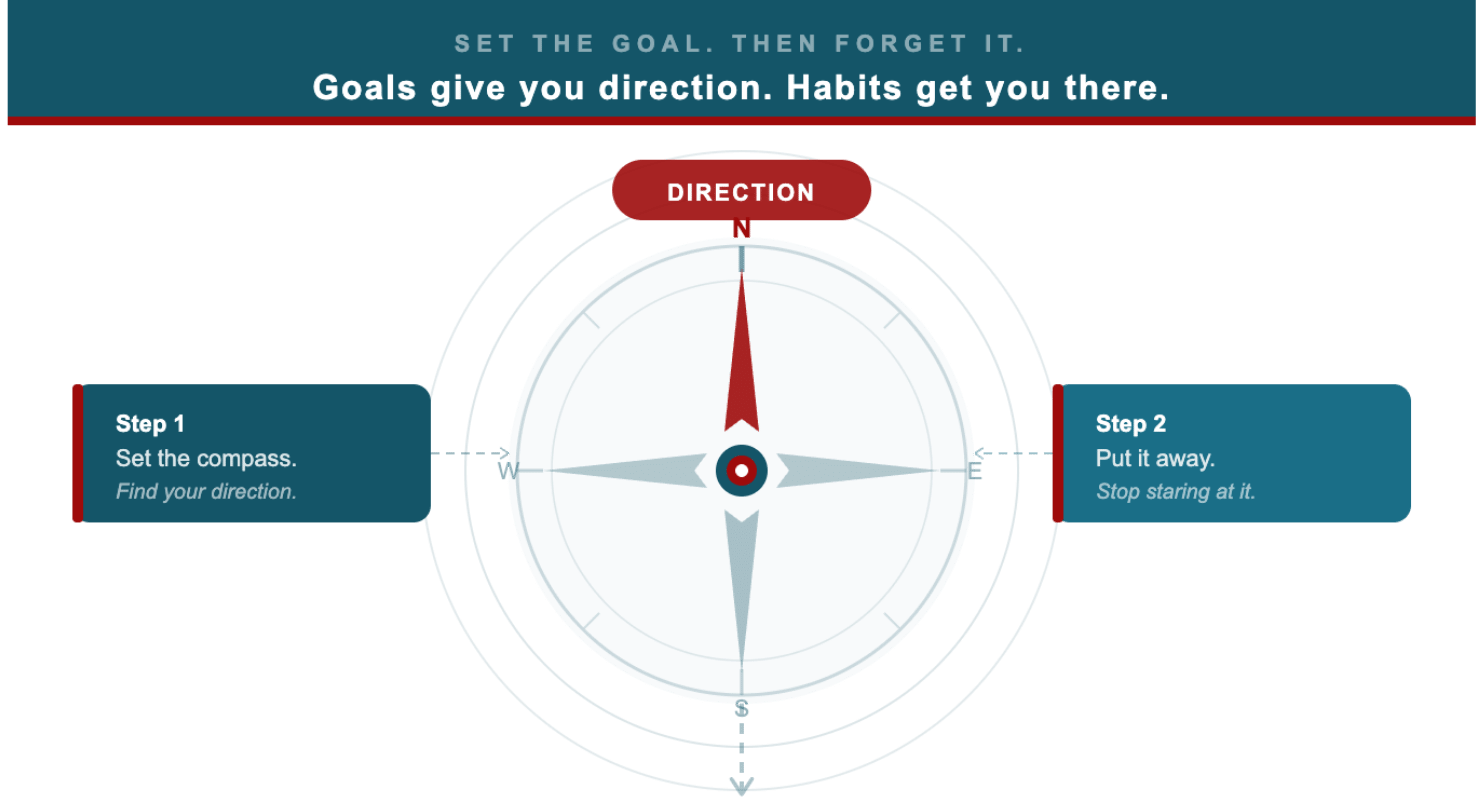
Goals give you direction. Habits get you there. Set the compass once — then follow the path, not the destination."
Gary Walker
Every journey needs a direction. Without one, anywhere looks fine - and that's exactly the problem.
Here’s something that maybe sounds like bad advice.
Set your goal. Write it down.
Get clear on exactly what you want.
Then forget about it.
Focus entirely on the doing - not the done.
I know.
It runs counter to almost everything you’ve heard about goal-setting. Vision boards. SMART goals. Keeping your eye on the prize.
But bear with me - because there’s solid neuroscience behind this, and once you understand it, the way you approach almost everything will shift.

The problem with staring at the destination
When your brain is focused on a goal it hasn’t achieved yet, it has to hold two things in tension simultaneously: where you are now, and where you want to be.
That gap - the distance between current reality and desired outcome - creates a kind of cognitive dissonance.
For some people, that tension is motivating. For most, over time, it’s demoralising. The goal stays fixed in the distance while daily life keeps being daily life. The gap doesn’t close fast enough. Motivation drops. The goal gets quietly abandoned.
There’s also a subtler problem. Research by Gabriele Oettingen found that when people vividly imagine their goal already achieved - the classic visualisation technique - their brains respond as if it’s partly done. Motivation actually decreases. The brain starts to relax before the work is finished.
The destination, stared at too hard, tricks the brain into thinking it’s already arrived.
What works instead
Process. Systems. Habits. The daily rep.
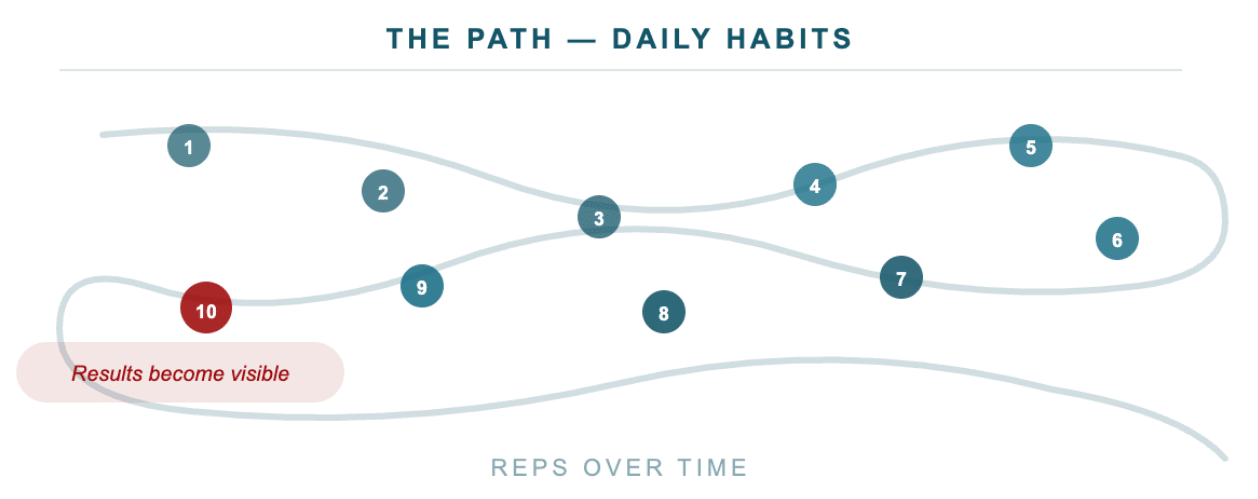
Instead of “I want to be mentally fit,” ask: what does a mentally fit person do each day? Then do that.
Not once - consistently, without obsessing over whether it’s working yet.
Your brain responds to repeated action. Every time you practise something - staying calm under pressure, noticing when you’re running low, setting your morning deliberately - the neural pathway gets a little stronger. Not because you achieved a goal.
Because you showed up and did the rep.
The compass is helpful - it tells you which direction to walk.
But once you’re walking, put the compass away and pay attention to the path.

The getting there, not the got there

There’s a difference between the person who trains because they want to be fit, and the person who trains because they enjoy training. The second person keeps going when results are slow. The first doesn’t.
The same applies to mental fitness.
If you’re practising only for the outcome - less anxiety, better focus, more resilience - every day that doesn’t deliver obvious results feels like failure. But if you find value in the practice itself - in the few quiet minutes of reflection, the deliberate morning, the moment of choosing response over reaction - you keep going regardless.
That’s not a mindset hack. It’s what the research consistently shows. Identity-based habits - “I am the kind of person who does this....” - outlast outcome-based goals every time.
Three practical shifts
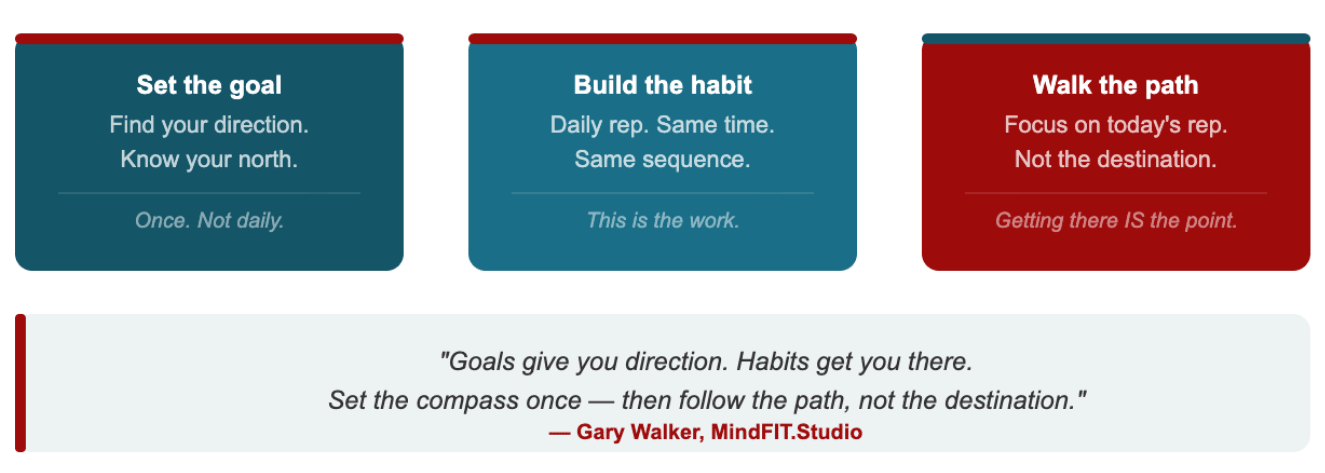
Convert your goal into a daily action
“I want better mental fitness” → “I do seven minutes of intentional mental training each morning.” The goal sets direction. The habits get you there
Track the streak, not the result
Don’t measure how mentally fit you are today. Measure how many days in a row you’ve done the thing. Consistency is the result. Everything else follows. Eventually it is so ingrained you no longer need to track it - its your identity to show up and do the work
Fall in love with the process
Find the version of the practice you actually enjoy - or at least don’t dread. The one you’ll do on tired days, bad days, busy days. That’s your real habit. Build around that.
Set the goal. Use it to find your direction. Then put it in your pocket, face forward, and walk.
The getting there is the whole point.
I'm a coach right ? I support others to achieve their goals and one of the key things that defines a good coaching session is to get clear on what people want. (not what they don't want)
A good example is weight management.
"I dont want to be fat.." : re-frame - "what do you want".
"I want to weigh XXKg" : get their purpose - "why?"
"OK - hypnotise me to get there" : true story :-)
Instead we work on them being the type of person that sleeps better, is active, has better nutrition and they demonstrate that with small daily habits.
Their purpose is in front of them - to take daily steps to being that person
Set your day
I wrote a post recently about how I set my day. My thought is that if I don't - others will set it for me.
If you want a practical daily structure to start with, the 4M Morning Framework is exactly that — a 28-minute habit that trains the path, not the destination.

Join a Live Group session
We share practical, science-backed content across key Mental Fitness areas and hopefully articles to ponder and ideas to expand your thinking and maybe make your life better.
New content is added regularly so subscribe below to get the latest news.
Neuroscience - how your brain actually works, in plain English
Mental Health - how to notice, support, and help yourself and others build mental resilience
Performance - how to train your mind like an athlete trains their body
Habits - How to create great habits and remove ones that don't serve
Musings - Thought pieces, articles to ponder and ideas to expand your thinking
Newsletters - copies of our latest thinking

No jargon. No crisis framing.
Just useful tools you can put to work today.
Welcome to your training ground.
Gary Walker, Mental Fitness Coach
Subscribe to our newsletter - "Train your Brain"

Our short newsletter is filled with life-hacks, 7 minute brain training sessions, Neuro-Nudges and a whole of interesting ways to think.feel.better.
...get a copy of our FREE
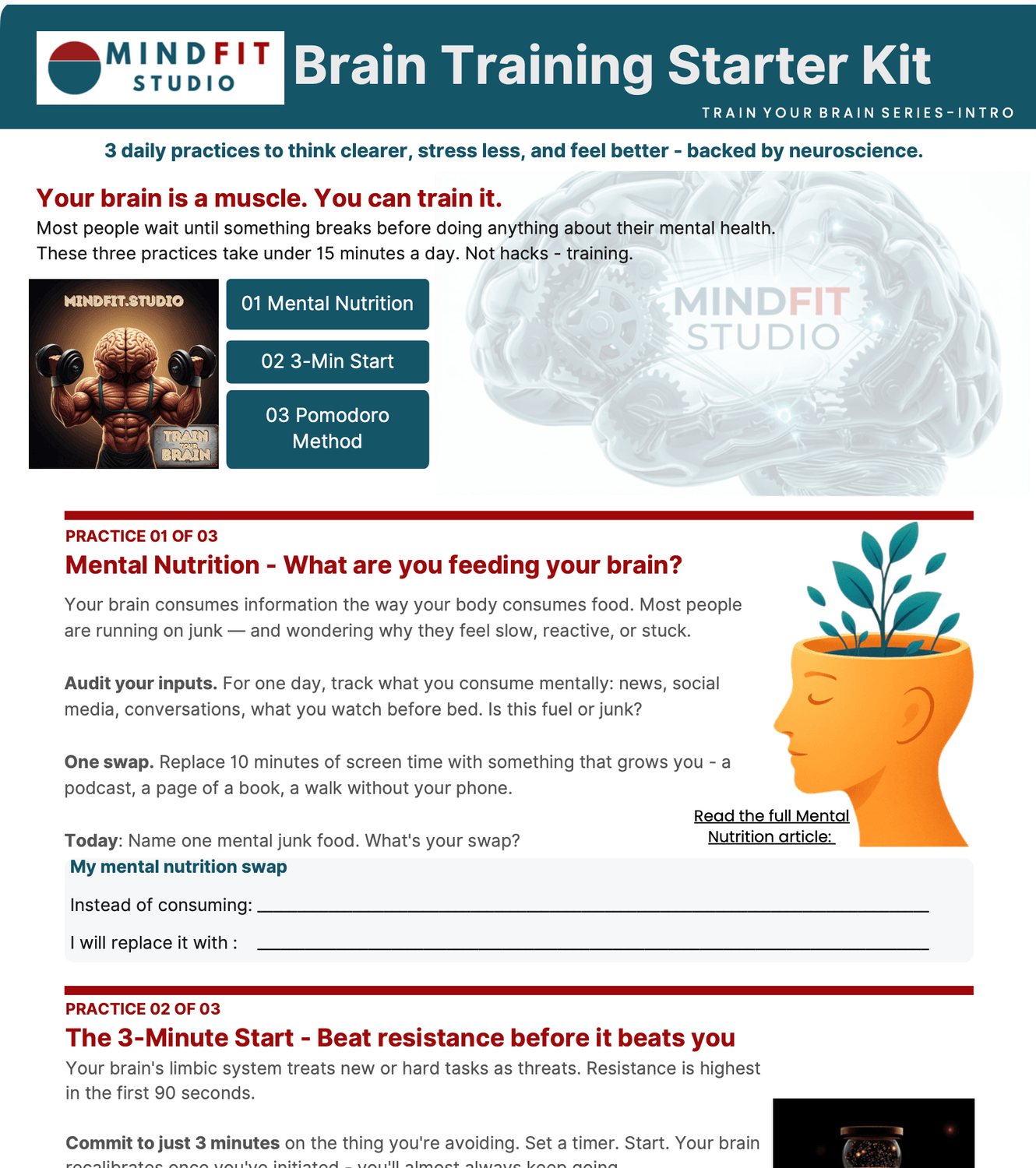
Brain Training Starter Kit
We created something special - our "Brain Training Starter Kit" has practical hints, tips and anti-procrastination tricks.
For now we are giving it away to those who subscribe to our regular newsletter
It's a sample from our larger Neuroscience based book providing 30 days of Brain training practices.
Copyright G2S T/a MindFIT.Studio
2026 - V1.8