


Set Your Day: The 7Min Morning Framework
"Just show up, do the work, it gets better."
Gary Walker
Most people don't set their day.
Their day sets them.
They wake up, reach for the phone, scroll through other people's urgency, and spend the next hour reacting.
By 9am the brain is already in catch-up mode - cortisol spiking, attention fragmented, the mental equivalent of starting a run having already pulled a hamstring.
Here's what I've learned after years of studying how the brain works and training others to use it better:
How you start the morning determines the quality of everything that follows.
Not because mornings are magic.
Because the brain is trainable - and the first 30-60 minutes of the day is the most powerful training window you have.
The key to anything is consistency.
The problem is most people don't have time, and that takes away the consistency.
The best exercise in the world is the one you actually do. The best routine is the one you actually practise.
Consistent action beats perfect action.
7 minutes is just a number. But it's a small one - short enough to cope with, yet filled with possibility.
Who's going to mind if you do more? Or less? It's just a guide.
This framework isn't only for mornings. The same 7-minute structure can apply to evening routines, exercise, cooking, learning, creativity - it's a framework for defeating inaction and procrastination.
Lets start here, in the morning.
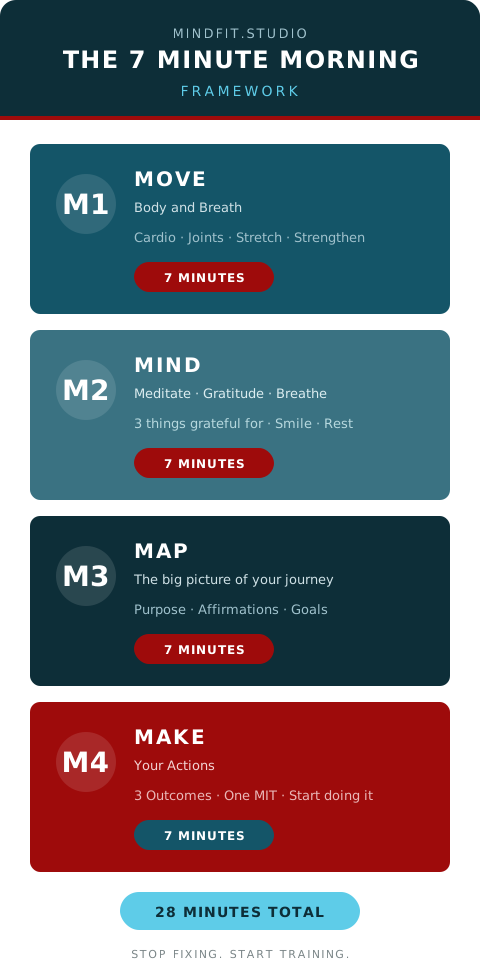
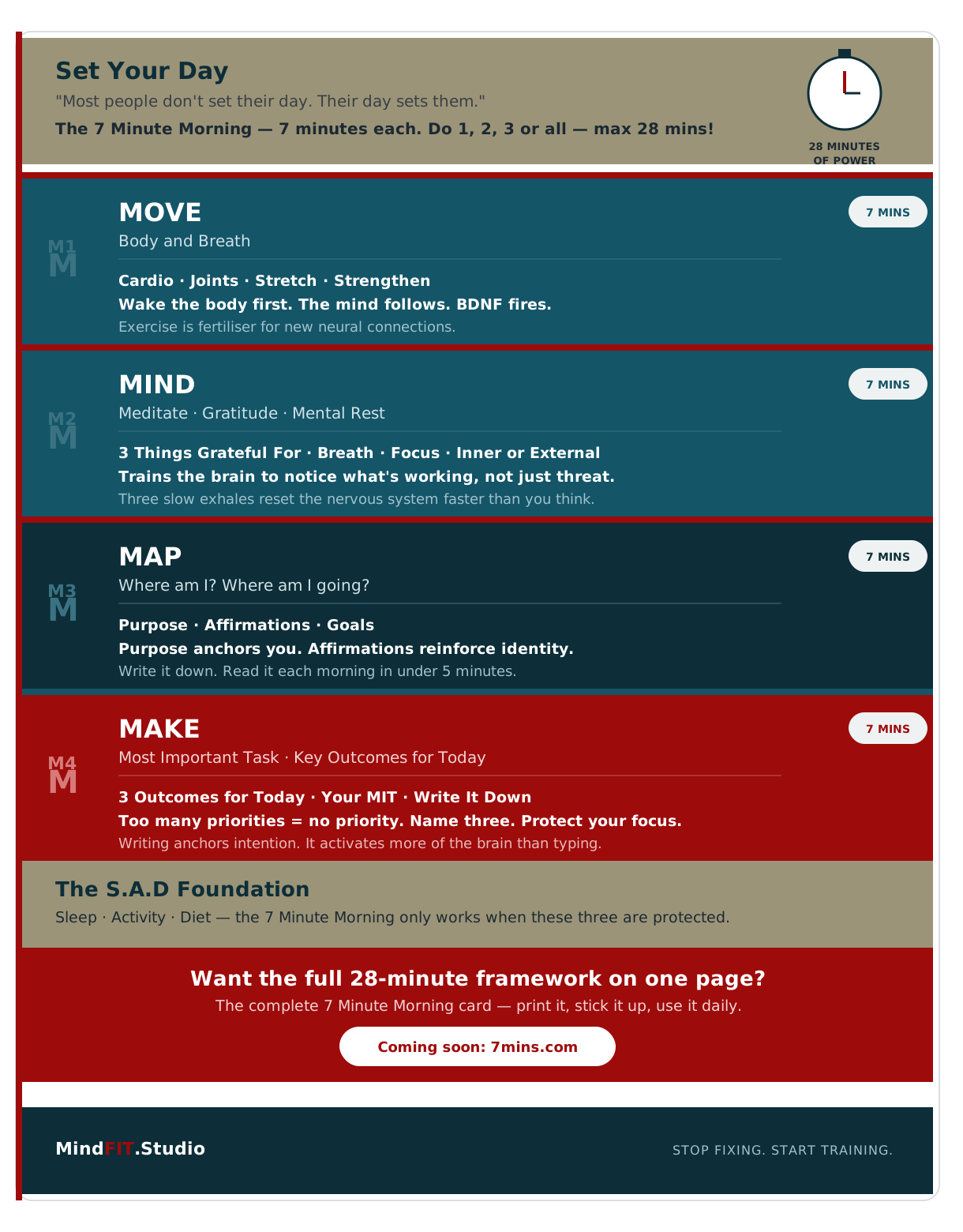
The 7 Minute Morning Framework
Key Points
Upto 7 minutes each.
28 minutes total.
Done before the noise arrives.

Don't have time?
Do less! Do 1, 2 or 3 or maybe even combine them all into 7 minutes with a bit of each!
The goal is not 7 minutes the goal is consistency
Roll out of bed (or stay in bed) - do one...
Why 7 minutes ?
Short enough for ANYONE to do, and build on
why not.? 🤪
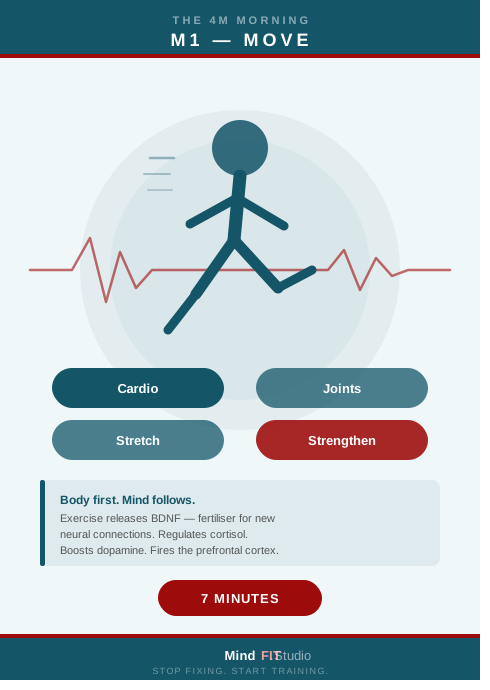
MOVE: Body and Breath
Before anything else - move the body. This isn't about a full gym session. It's about waking up the physical system so the mental system can follow.
The 7 Minute morning starts with just movement - sometimes just to move the joints (shoulders, trunk, knees, ankles, hips - unglamorous but important, especially as we get older), some cardio, i.e skipping or big walks - anything that raises the heart rate. Stretch (back and hamstrings, moving with the breath), and some basic strength work.
I've done this for years - a good session is 7 minutes!
The neuroscience behind this is solid. Exercise increases BDNF: Brain-Derived Neurotrophic Factor - essentially fertiliser for new neural connections. It regulates cortisol, boosts dopamine, and improves prefrontal cortex function - the part of your brain responsible for decision-making, focus, and emotional regulation.
You don't think your way into a good morning. You move your way there first.
MIND: Meditate · Mental Rest
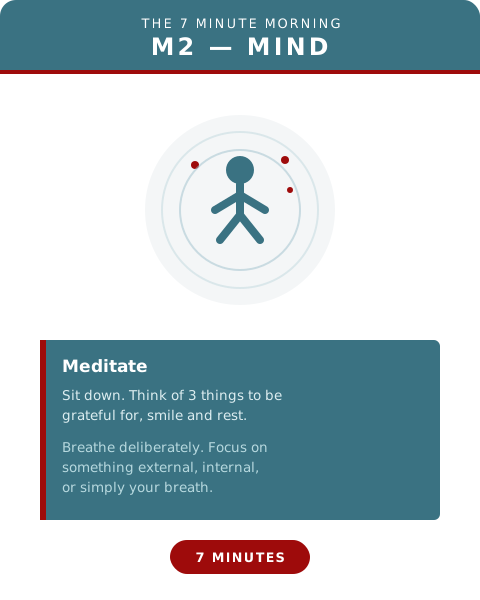
Once the body is awake, the second M is working the MIND
Set your day with thinking of just 3 things you are grateful for. Gratitude sets your mind to see the good - no matter the reality. The gratitude part isn't fluff. It has measurable effects on the brain's reward circuitry - it trains neural pathways toward noticing what's working, rather than constantly scanning for what's wrong. The brain is wired for threat detection by default. Gratitude is the deliberate counter-training. Then smile - rest in that happiness.
Meditate. Rest the mind. Focus on something external, something internal, or simply your breath. Three to seven minutes of deliberate quiet before the day starts talking at you. Use a timer or smartwatch. When you find your mind wandering and you notice - congratulate yourself! That IS meditation - you catch yourself and bring it back to present moment.
Most people skip this because they think it requires more time or skill than they have. It doesn't. Even three slow exhales - longer out than in, are enough to begin shifting your nervous system from reactive to responsive mode.
Your nervous system has two modes. Threat response: cortisol, adrenaline, tunnel vision. And rest-and-digest: calm, creative, present. Most people wake up already in threat mode thanks to alarm clocks, notifications, and the general noise of modern life.
The MIND block is your reset before the noise begins. A few minutes of happy, deliberate stillness is worth more than most people realise.
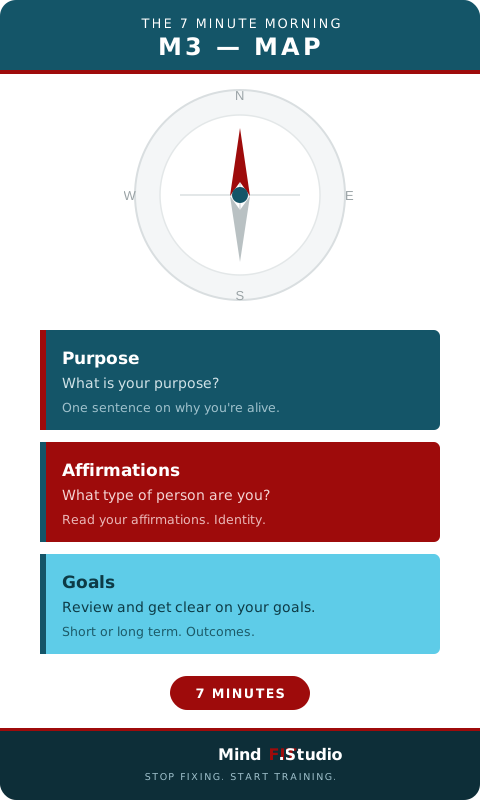
MAP: Where Am I? Where Am I Going?
Grab some mental nutrition. This is the hardest block to set up — and the most essential. Three parts. Write them out properly once, then
read them each morning in under five minutes.
PURPOSE: What is your purpose? One sentence on why you're alive -
not your job title, your meaning. E.g"I live to serve others, feel valued, find joy in the moments, and surround myself with caring people who make me smile."
AFFIRMATIONS (Identity)
What type of person are you? Read your affirmations: 4–5 lines that reinforce who you are at your best.
E.g. "I am fit, lean and strong. I earn money easily. I am loved,
loving and kind. I am getting better each day."
Done properly, affirmations aren't wishful thinking - they
reinforce identity. Repeat them enough and your brain starts
confirming them through your behaviour.
GOALS (Outcomes)
Review and get clear on your goals — short or long term.
Pick one area and set a mini-goal.
E.g."I will weigh 75kg by March. I will read 5 books by August."
Five to seven minutes on these three things is worth more than an hour of scrolling.
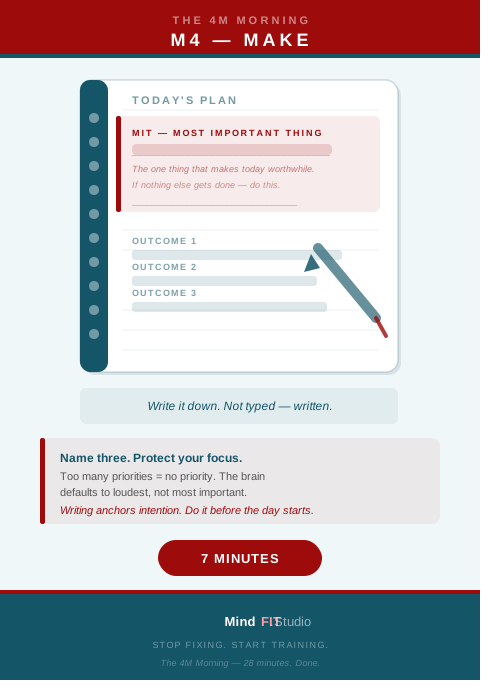
MAKE: the most of your day - what's the plan?
The last M is the most practical - and the one most people do wrong.
Review your calendar. What are your have to items. Remember - what gets scheduled - gets done.
List your three important tasks/outcomes for the day. Three things that, if completed, would make today a success. (you can have a side list of all other stuff if you want to keep track - but its distraction)
This matters because the brain struggles with too many priorities. Naming three outcomes in advance protects your focus before the noise of the day arrives.
Within those three, identify your MIT - the Most Important
Thing. The one thing that, if nothing else got done, will make today worthwhile.
Take some action - start doing it - no matter how small the start.
PS - Write them down. Physically. The act of writing anchors intention in a way that typing doesn't - it activates more of the brain and improves both recall and follow-through.
Then go. The day is set.
The 7 Minute Morning doesn't need to take two hours.
Done consistently, it runs in 28 minutes. Some mornings less.
What matters is the showing up, not the duration.
The brain responds to patterns.
Do this consistently and the routine itself becomes a signal: your nervous system starts to associate this sequence with focus, calm, and forward motion.
You create a powerful habit - and habits compound
That's neuroplasticity working for you rather than against you.
Set your day. Don't let your day set you.

Deliberate. Consistent. Trainable.
SAD is an emotion but we can turn that word into the three pillars of physiological and mental health to help set our days.
Sleep: Key to feeling great or feeling bad. So get it right!
Activity: Movement, or the lack of it, affects your body / mood.
Diet (aka anything you put into your body!) Good nutrition feeds the body, mood and mind.
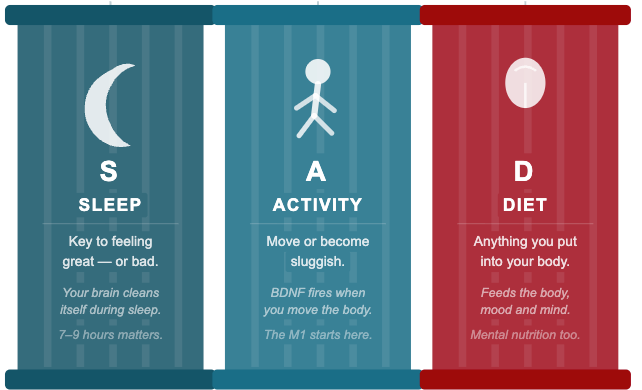
Get the foundation right. Build the morning on top of it.
Recently in my Mental Health First Aid courses I teach (mhfa.co.nz) we added SaM to the SAD acronym.
SaM = Social Connection and Meaning (connect with others and find joy, awe, purpose)
SADSaM
We share practical, science-backed content across key Mental Fitness areas and hopefully articles to ponder and ideas to expand your thinking and maybe make your life better.
New content is added regularly so subscribe below to get the latest news.
Neuroscience - how your brain actually works, in plain English
Mental Health - how to notice, support, and help yourself and others build mental resilience
Performance - how to train your mind like an athlete trains their body
Habits - How to create great habits and remove ones that don't serve
Musings - Thought pieces, articles to ponder and ideas to expand your thinking
Newsletters - copies of our latest thinking

No jargon. No crisis framing.
Just useful tools you can put to work today.
Welcome to your training ground.
Gary Walker, Mental Fitness Coach
Subscribe to our newsletter - "Train your Brain"
Our short newsletter is filled with life-hacks, 7 minute brain training sessions, Neuro-Nudges and a whole of interesting ways to think.feel.better.
...get a copy of our FREE
Brain Training Starter Kit
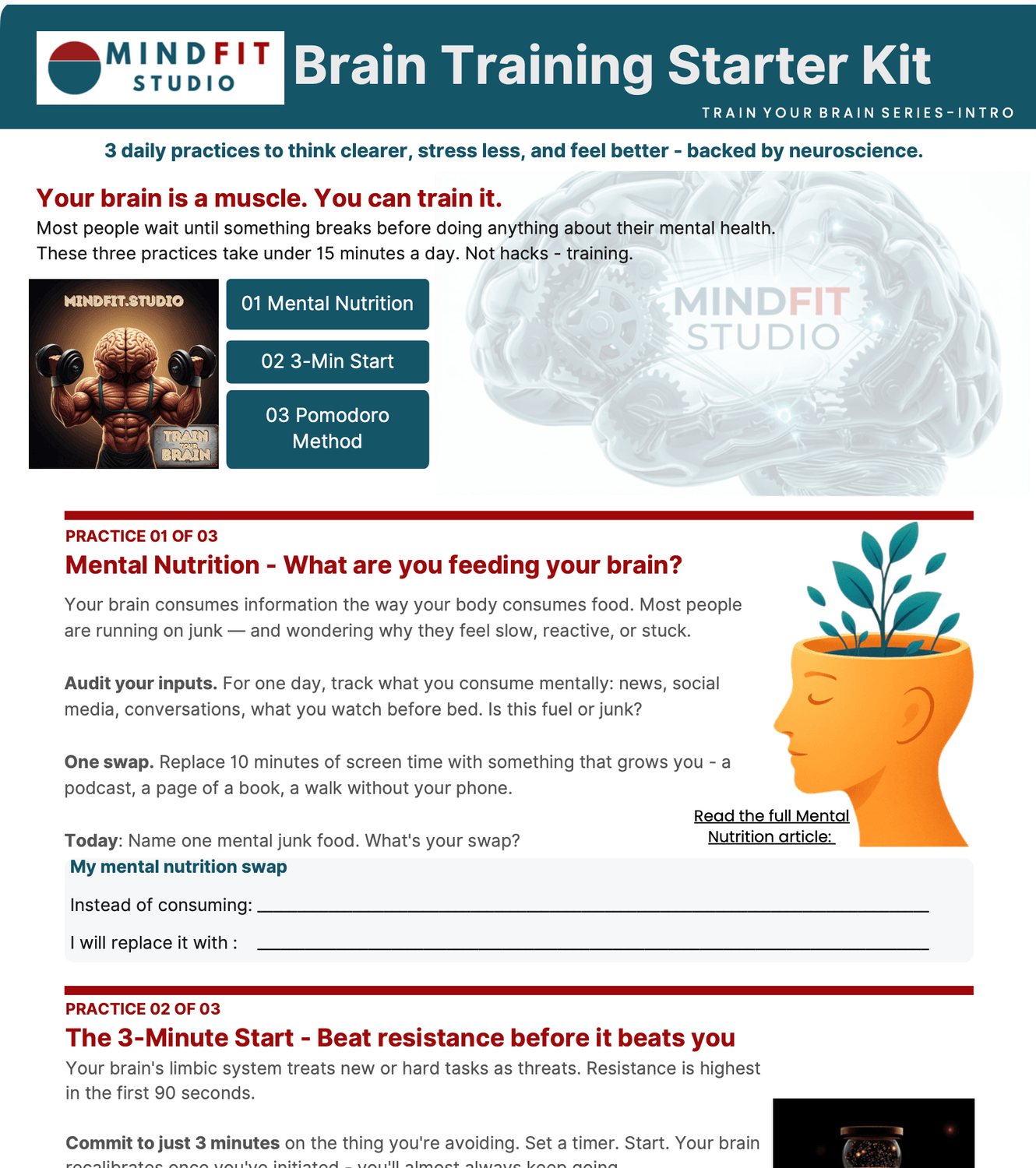
We created something special - our "Brain Training Starter Kit" has practical hints, tips and anti-procrastination tricks.
For now we are giving it away to those who subscribe to our regular newsletter
It's a sample from our larger Neuroscience based book providing 30 days of Brain training practices.
Copyright G2S T/a MindFIT.Studio
2026 - V1.8