


How do you roll through life?
“If you don’t have a direction, anywhere from here is good.”
There’s something quietly unsettling about that sentence.
Read it again.
If you don’t have a direction, anywhere from here is good.
It sounds like freedom.
But spend a moment with it and you’ll notice it’s not.
It’s drift.
And drift, over time, looks a lot like a life that happened to you rather than one you chose.

Self-discovery isn’t a retreat weekend or a personality quiz. It’s the ongoing, sometimes uncomfortable process of asking: who am I, and is the way I’m living consistent with that?
Most people never ask. Not because they don’t care - but because life fills every gap before the question has a chance to form.
Work, family, notifications, obligations. The noise is constant. And in constant noise, the quieter questions don’t get heard.
Why this matters for mental fitness

Your brain is wired for consistency.
It likes predictability, pattern, and purpose.
When your actions align with your values - when what you do matches who you believe you are - your nervous system runs cleaner.
Less friction.
Less of that low-grade sense that something is off.
When they don’t align, you feel it.
Not always loudly. Sometimes it’s just a background hum.
A vague restlessness.
A sense of going through the motions.
That hum is information. It’s worth listening to.
Three questions worth sitting with
These aren’t quick questions. Sit with them properly - not on your phone, not between meetings.
Write the answers down.
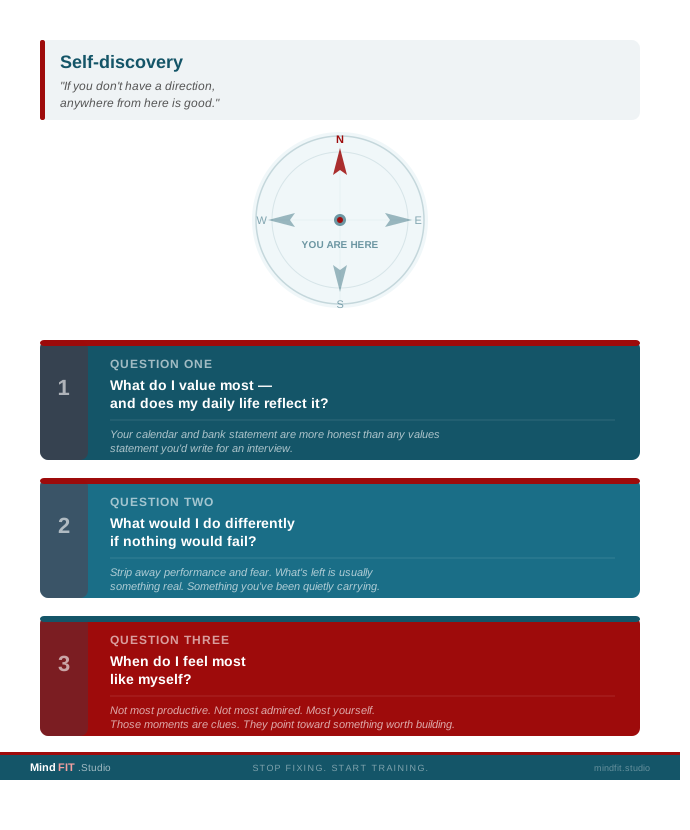
What do I value most - and does my daily life reflect it?
Values aren’t what you say you care about. They’re what you give your time, attention and energy to when nobody’s watching. Your calendar and your bank statement are more honest than any values statement you’d write for an interview.
If you say you value family but work 70 hours a week, that’s information. If you say you value health but haven’t moved your body in three months, that’s information too. No judgement - just honesty.
What would I do differently if I knew nobody was watching and nothing would fail?
This question strips away performance and fear simultaneously. What’s left is usually something real. Something you’ve been quietly carrying.
It doesn’t mean throw everything away. It means notice what’s there.
When do I feel most like myself?
Not most productive. Not most admired. Most yourself. The moments when something clicks, when time dissolves, when you’re fully present without effort.
Those moments are clues. They point toward something worth building.
Direction doesn’t need to be dramatic
Self-discovery doesn’t require a career change or a trip to find yourself.
It starts with honesty. Small, consistent honesty about who you are, what you want, and whether you’re moving toward it or away from it.
The brain responds to direction. Give it one - even a rough one - and it starts organising itself around it.
Neural pathways consolidate. Decisions become easier.
You stop expending energy on drift.
Direction is a mental fitness tool. Use it.
Consistent. Practical. Honest

“Knowing yourself is the beginning of all wisdom.”
- Aristotle
I have my life purpose which I have above my desk and at the top of all my notes..
To live in AWE, be curious and be of value to self, others and our world
That means that I try to be present and not plan everything - however by setting an intention each day as to what would make today amazing and outcomes I would love to see - helps guide me, decisions and habits that may otherwise take me off my path.
As mentioned above - Direction is a mental fitness tool. Use it.
Set your day
I wrote a post recently about how I set my day. My thought is that if I don't - others will set it for me.
Not saying that I am not open to the vagaries of life - and I like to be present to whatever happens.
Each day I create a small plan in under 3 minutes and each night I remind myself of the gratitude moments..

Join a Live Group session
We share practical, science-backed content across key Mental Fitness areas and hopefully articles to ponder and ideas to expand your thinking and maybe make your life better.
New content is added regularly so subscribe below to get the latest news.
Neuroscience - how your brain actually works, in plain English
Mental Health - how to notice, support, and help yourself and others build mental resilience
Performance - how to train your mind like an athlete trains their body
Habits - How to create great habits and remove ones that don't serve
Musings - Thought pieces, articles to ponder and ideas to expand your thinking
Newsletters - copies of our latest thinking

No jargon. No crisis framing.
Just useful tools you can put to work today.
Welcome to your training ground.
Gary Walker, Mental Fitness Coach
Subscribe to our newsletter - "Train your Brain"
Our short newsletter is filled with life-hacks, 7 minute brain training sessions, Neuro-Nudges and a whole of interesting ways to think.feel.better.
...get a copy of our FREE
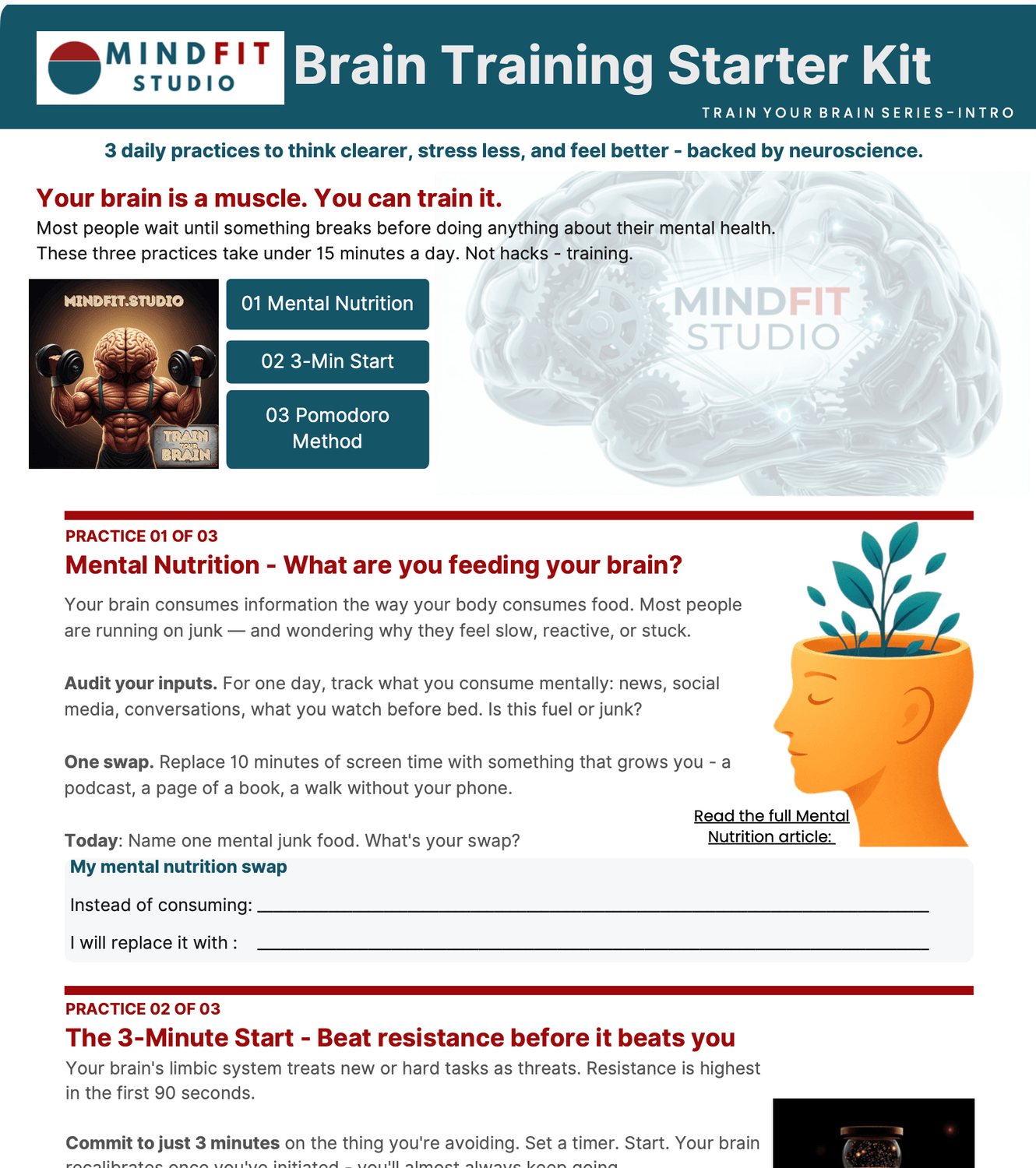
Brain Training Starter Kit
We created something special - our "Brain Training Starter Kit" has practical hints, tips and anti-procrastination tricks.
For now we are giving it away to those who subscribe to our regular newsletter
It's a sample from our larger Neuroscience based book providing 30 days of Brain training practices.
Copyright G2S T/a MindFIT.Studio
2026 - V1.8