



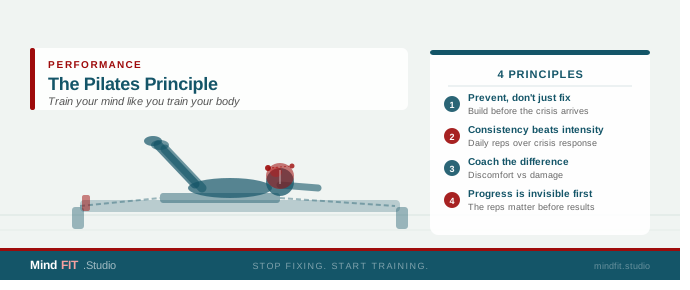
The Pilates Principle: Train Your Mind Like You Train Your Body
"Just show up, do the work, get better."
Gary Walker
You already know the basics of physical exercise.
Raise the heart rate.
Move the limbs.
Push the muscles
An inactive body leads to slow movement, poor metabolism and the chance of injury increases..
Why is that any different to your mind?

I started Pilates a few years ago.
And somewhere between learning to breathe properly and figuring out why my core was apparently non-existent, something clicked for me professionally.
This is exactly what mental fitness should look like.
Not the dramatic, crisis-focused, "are you okay?" version of mental health that most organisations default to.
But the deliberate, consistent, progressive training approach that every good physical fitness programme is built on.

Here's what exercise taught me - and what it has to do with your brain:
You don't wait until you're injured to start.
Pilates is preventive. You build core strength, flexibility, fitness and body awareness before your back gives out - not after.Mental fitness works the same way. You build the skills, habits, and resilience before the crisis - not in response to it.
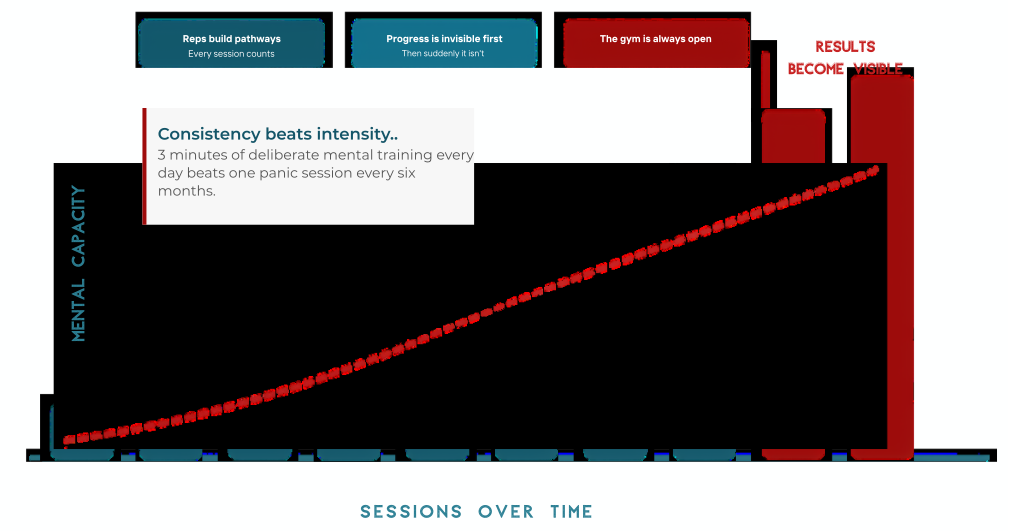
Consistency beats intensity.
Nobody does one Pilates session and walks out transformed.
The results come from showing up regularly, doing the work, and building capacity over time.
Three minutes of deliberate mental training every day beats one hour of panic-driven crisis response every six months.You need a coach who knows the difference between discomfort and damage.
Good Pilates instruction pushes you, it's not always comfortable, but it knows the difference between productive challenge and injury.
Mental fitness coaching works the same way.
Some discomfort is part of the process. But struggling alone, unsupported, isn't a growth strategy.Progress is invisible until it isn't.
You don't feel yourself getting stronger in Pilates session by session.
Then one day you realise you can do something you couldn't before.
Mental fitness is the same - the reps matter even when you can't see the results yet.
The question I ask every organisation I work with is this:
You invest in physical health - gym memberships, ergonomic chairs, healthy snacks in the kitchen.
What's your equivalent investment in mental fitness?
Not a crisis line. Not a counselling referral after someone breaks down. (thats fixing, not training)
A proactive training programme.
Built into the culture.
Consistent. Practical. Trackable.
That's the Pilates principle applied to mental health.
And that's what we're building at MindFIT.Studio.

Watch your thoughts, reframe constantly to remove blame and accept responsibility.. this is tough practice - the hard reps
If you find yourself thinking irrationally, feeling angry, step outside your own head and look at those thoughts with curiosity instead.... "isn't that interesting?"
What 3 things that happened today are you grateful for? What was marvellous? Find 3 just before you head off to sleep
Mental Nutrition
At MindFIT.Studio, we also have an expression - Mental Nutrition
The idea that what you feed your mind matters just as much as what you put in your body.
The thoughts you practice, the habits you build, the skills you train.
All of it shapes how your brain performs under pressure.

Explore our workshop programme
We share practical, science-backed content across key Mental Fitness areas and hopefully articles to ponder and ideas to expand your thinking and maybe make your life better.
New content is added regularly so subscribe below to get the latest news.
Neuroscience - how your brain actually works, in plain English
Mental Health - how to notice, support, and help yourself and others build mental resilience
Performance - how to train your mind like an athlete trains their body
Habits - How to create great habits and remove ones that don't serve
Musings - Thought pieces, articles to ponder and ideas to expand your thinking
Newsletters - copies of our latest thinking

No jargon. No crisis framing.
Just useful tools you can put to work today.
Welcome to your training ground.
Gary Walker, Mental Fitness Coach
Subscribe to our newsletter - "Train your Brain"
Our short newsletter is filled with life-hacks, 7 minute brain training sessions, Neuro-Nudges and a whole of interesting ways to think.feel.better.
...get a copy of our FREE
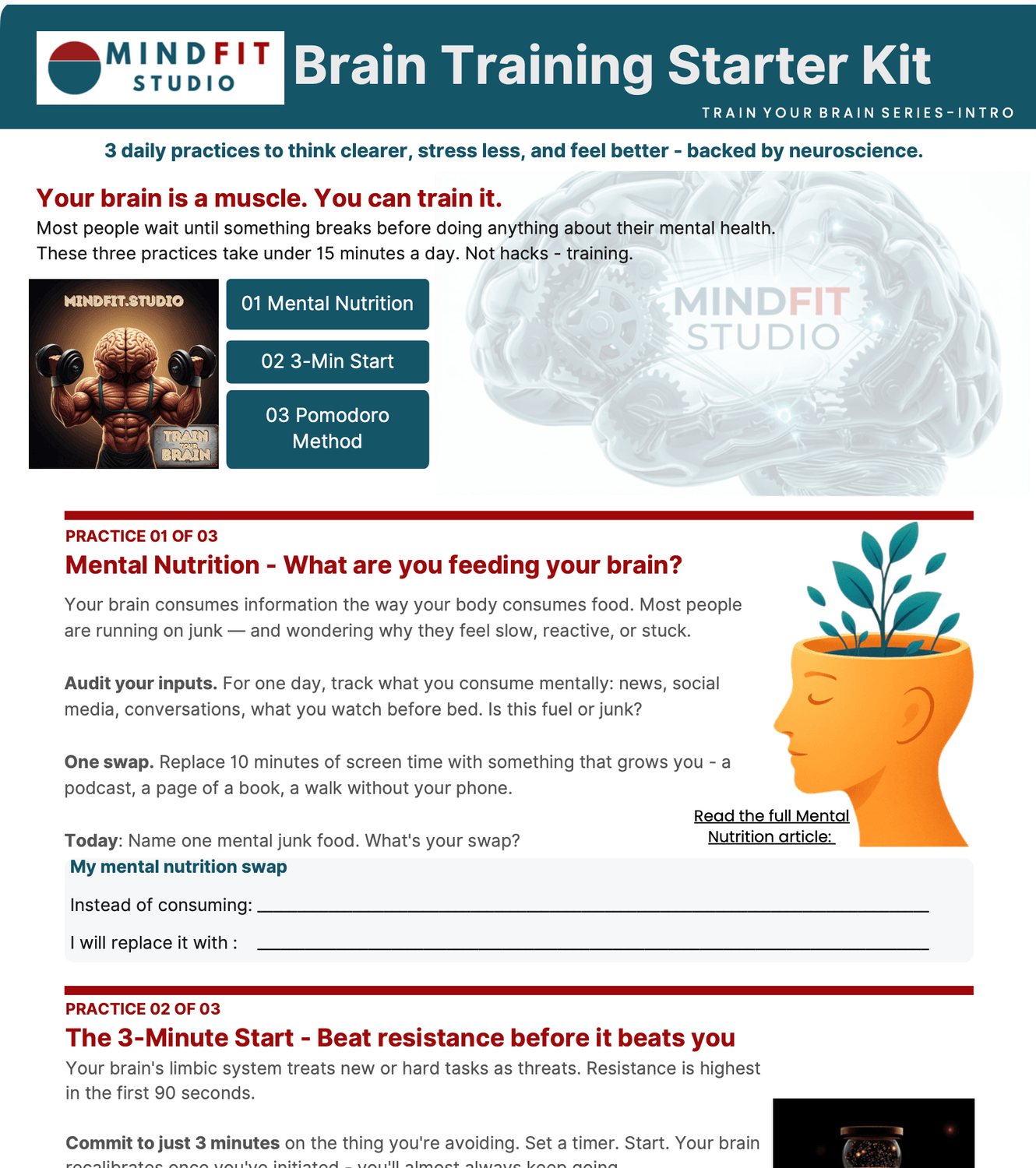
Brain Training Starter Kit
We created something special - our "Brain Training Starter Kit" has practical hints, tips and anti-procrastination tricks.
For now we are giving it away to those who subscribe to our regular newsletter
It's a sample from our larger Neuroscience based book providing 30 days of Brain training practices.
Copyright G2S T/a MindFIT.Studio
2026 - V1.8